Thursday, 16 June 2016

Chemical Dynamics of Water Pollution

Chemistry has a long history – is it now time to turn our attention to repairing the damage chemical pollution has inflicted on the environment?

The origins of today’s scientific chemistry date to the turn of the 18th century from experimentation on water, combustion, medicine, and the study of heat.

With the experiments of Joseph Priestly, Antoine Lavoisier, Joseph Black, and Robert Boyle, modern-day chemists learned to understand the differences between alchemy and physical science.

Early Chemists


Although modern chemistry is a relatively new undertaking, the basis of chemistry lies within the origins of civilization. Although some recall the alchemists as early chemists, Alchemy originated from shamanic practices–inspiring their art with mysticism.

The first chemists were pragmatists–their discoveries came from necessity. The original science came from the hunter-gatherers who foraged for grubs, berries and discovered properties of the bark of the Willow tree (a source of primitive aspirin).

Other propitious discoveries included utilizing the foxglove plant for angina and the carrot for pigmentation. Moreover, several thousands of years later, primitive metallurgists utilized iron and bronze for plowing the earth and for weapons. Thus, between then and now, the science of chemistry grew to be appreciated and respected.

From soaps and diabetes medications to paints and gasoline, chemistry made our lives better and simpler.

The Dual-Edged Sword of Chemistry


Many lives have been saved, and riches have been amassed from the modern science of chemistry. However, many lives have also been ruined, and our world’s ecosystem is imperiled from a reckless use of chemistry.

Sadly, we have been poor stewards of the bigger picture. Every day, large volumes of chemicals pollute the  water. The sheer volume appears unimaginable, but it has initiated changes in the biosphere.

Organic chemicals include oil spills, agricultural runoff, and litter ranging from plastic bags to automobile tires.

Inorganic chemicals include litter, smoke and ash from coal-powered plants, and toxic metals (Cobalt, Arsenic, Antimony, Tin and Nickel).

This is the dual-edged sword of chemistry–it is a human aspect. Continue reading..

Wednesday, 15 June 2016

What is the Purpose of Chromatography?

Chromatography

Finding, isolating, and characterizing medicines derived from nature is a major sub-discipline within chemistry. One often-used technique for isolating potential medicinals is called chromatography – this is a process that separates similar molecules in a mixture.

Early methods separated molecules by color, so scientists called the process, ‘chromatography.’ How is this technique useful?

Chromatography Uses: Drugs From Food


An instance of a potential ‘drug’ isolated from food came from red wine in the 1990s. The substance known as resveratrol gained widespread acclaim as the possible ‘drug.’

Resveratrol was a part of the French paradox — how can people ingest rich, high calorie foods accompanied with a hearty Bordeaux or Pinot Noir wine without increasing their risk of a heart attack or stroke?

The paradox puzzled researchers, and identifying resveratrol as a preventative agent for heart disease was a stroke of scientific genius.

Resveratrol and chemically-similar compounds occur in wine grapes and are classified as phenolic stilbenes, substances which result from plant biochemistry. The eventual isolation of resveratrol via chromatography resulted in isolating other similar molecules of importance.

What are Phenolic Stilbenes–or Polyphenols?


The term stilbene originates from the german, stilbein~ to phosphoresce. The original discovery of the ‘stilbene class’ of molecules came in the late 1800s and was named as such because the molecule possessed a peculiar glow. Presently, theoreticians regard the molecule as rather mundane, except for the biochemical properties that were discovered in the mid-1990s. Continue reading..


Tuesday, 14 June 2016

How to Find Mass from Mole Fraction?

Mole fraction is simply the moles of a particular substance divided by the total number of moles present. Mole percent is mole fraction times 100. Similar to mole fraction, the mass fraction is nothing more than the mass of the substance divided by the total mass of all substances present. Although the mass fraction is what is intended to be expressed, ordinary usage employs the term mass fraction as well.

Mass (weight) fraction = mass (weight) of A / total mass (weight).

The term mass fraction and mole fraction are dimensionless. Mass percent is the amount of solute in grams present in 100g of the solution. Mole fraction is the ration of number of moles of a particular component to the total number of moles of the solution.

Let’s solve a problem based on mass and mole fraction.

Problem:

Consider 10mg of deprenyl is diluted in 10ml water. Water has the density of 1.0 g/ml. Calculate the mass fraction of the drug.

Solution:

To find the mass fraction first find the total mass of the solution, which is mass of water plus the mass of deprenyl.

m_{water} = (1.0g/mL) (10 mL) = 10g

Note that mass of the drug is negligible compared to the mass of water.

m_{total} = m_{water} + m_{drug} ~  m_{water}

The mass fraction of the drug is,

W_{drug} = m_{drug} / m_{water} = (10 mg/10g) (1g/1000mg) = 1.0 x 10^{-3}.

Thursday, 9 June 2016

Examples of Endothermic Reactions

Endothermic reactions absorb heat energy from the surroundings. So that the temperature of the surroundings decreases. In endothermic reaction, the products formed are at a higher energy level than that of the reactants; hence energy is absorbed by the reactants from the surroundings.

Photosynthesis is an endothermic reaction. 


In endothermic reactions, more energy is required to break bonds than is required to make bonds. Energy is absorbed and the surroundings get cooler. Sometimes you may see sportsman and women putting cold packs on injured ankles, knees or other parts of their bodies. One types of cold packs uses an endothermic reaction to work. The cold packs contains water and ammonium nitrate. As the ammonium nitrate dissolves in water an endothermic reaction takes place and the ice pack becomes very cold.

Some of the examples of endothermic reaction are given below:
  1. Decomposition of compounds such as calcium carbonate, copper (II) carbonate, sodium nitrate etc.
  2. Food being cooked.
  3. Photosynthesis where green plants absorb light energy to make starch.
  4. Dissolution of ionic salts like ammonium chloride, ammonium nitrate and sodium carbonate crystals in water.
  5. Taking a photograph with a film, light energy is absorbed to decompose the silver bromide on the film to silver and bromine.
Endothermic reactions are less common than exothermic reaction, but there are a number which are quite familiar. For example, when certain salts such as potassium chloride and ammonium nitrate dissolve in water they take in heat from the surroundings and the temperature of the solution drops.
 

Tuesday, 7 June 2016

Subscripts and Superscripts in Chemistry

Subscript and superscript can make all the difference when it comes to chemical formulas.

Molecules, compounds, and other chemical structures include more than one atom. Sometimes, there are multiples of one particular atom. For instance, anhydrous aluminum chloride features one atom of aluminum joined to or combined with three atoms of chlorine. Its chemical formula reflects this: AlCl3. But – simply knowing how to use a number in this instance is not enough. It is essential to know the proper use of subscripts and superscripts.

Subscripts in Chemistry


Notice the number 3 is written as a subscript, or a number that is smaller than the other text, and below the normal text line, in the formula for anhydrous aluminum chloride above. The concept of a multiplicity of atoms is conveyed by this use of a subscript.


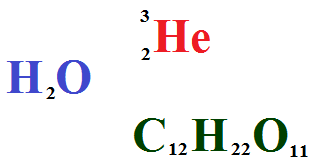
You can also write the formula for Sucrose or table sugar, using chemical symbols and subscript numbers. There are 12 carbon atoms, 22 hydrogen atoms, and 11 oxygen atoms in sucrose – the chemical formula for table sugar looks like this: C12H22O11.

Sometimes parentheses are used to characterize a particular structure, as follows: (CH3)3CCOOH

The above molecule is pivalic acid. We occasionally refer to this molecule as trimethylacetic acid, since, visually, the molecule contains 3 methyl groups CH3-. Written in its most elemental form, the formula for pivalic acid is C5H10O2.

Another more complex structure – acetone, or dimethyl ketone – exemplifies the beneficial use of parentheses.

CH3(CO)CH3

How are the parentheses beneficial? In this instance, it is because the oxygen atom is not connected to either the leftmost or the rightmost carbon atom but only the middle carbon atom. Acetone’s chemical structure could also be written (CH3)2CO or (CH3)2C=O.


Superscripts in Chemistry


Atoms often occur as combinations of isotopes. Hydrogen, the simplest gaseous element, has one electron and one proton in all its atoms. However, a small percentage of hydrogen atoms also have a neutron in the nucleus. This form of hydrogen atom is, naturally, heavier than the hydrogen without a neutron. To distinguish them, a superscript is employed. The letter H with a left-justified superscript symbol 1, written 1H, represents hydrogen containing one nucleon – that is one nuclear particle – a lone proton. Continue reading..

Friday, 3 June 2016

Hydrogenation of Benzene

Benzene hydrogenation is a major petrochemical process. Benzene is readily hydrogenated to cyclohexane using nickel or platinum in fixed beds. Most of the cyclohexane nearly 98% is produced by benzene hydrogenation process. Generally this reaction is carried out at 160 – 220$^{\circ}$C and 25 – 30 atm. Many catalyst such as Ni/alumina and Ni/Pd are used for the reaction.

Hydrogenation of Benzene

Benzene hydrogenation has been chosen as a model aromatic substance. This reaction has also been used as model reaction in heterogeneous catalysis by metals where metal-support interactions are involved and the desired product of benzene hydrogenation – cyclohexane is an important chemical intermediate for the synthesis of nylon-66 and nylon-6.

During hydrogenation of benzene some two important observations are made.
  1. Partially hydrogenated benzene derivatives were never found – only reaction ends in the formation of cyclohexane.
  2. Cyclohexane was dehydrogenated above 200oC to give the reverse reaction. At higher temperatures benzene cracked to form methane and carbon.

Benzene must be free from sulfur to avoid poisoning the catalyst although the original short uneconomical catalyst were common. Reaction temperature and exotherm can be controlled by evaporation of the product and dilution of the benzene feed with recycled cyclohexane.

Friday, 27 May 2016

Atomic Interactions - Wavefunctions, Orthogonality, Orbitals, Hybridization, & Bonding

Nobel Prize-winning theoretical chemist Linus Pauling wrote a most famous book in 1939, entitling it, The Nature of the Chemical Bond and the Structure of Molecules and Crystals: An Introduction to Modern Structural Chemistry.

There have been few facets of chemistry of greater importance.
Hybridization
Hybridization


Here, we will discuss basic concepts that we hope will lead our readers to a better understanding of what goes on between atoms. We will consider the bonding between carbon atoms in particular.

Wavefunctions

Quantum mechanics is a mathematical discipline that defines the nature and behavior of tiny particle systems, such as atoms and molecules.

At the atomic and subatomic level, particles and waves share similar properties, each isolated system containing one or more particles is described by a mathematically descriptive equation called a wavefunction.
Operators

In mathematics, numbers can be “operated on” to produce certain results. For instance, 3 and 4 can be operated on by multiplying them with each other, to produce the result, 12. Wavefunctions can be operated on in various ways to produce mathematical results that correspond to physical properties. If two wavefunctions are multiplied together yielding the value zero, the wavefunctions are said to be orthogonal.

Orthogonality

An approximate definition for the word orthogonal is perpendicular – this applies to wavefunctions that are orthogonal – they do not interfere with each other. Thus atomic orbitals are orthogonal – they don’t interfere with each other. Continue reading..